Explore the art of Japanese Sadō, where every gesture, bowl, and season carries a centuries-old philosophy blending hospitality, aesthetics, and spirituality.
In a room just a few tatami mats wide, silence reigns. The only sound is the soft murmur of water simmering in the kettle. The host picks up a bamboo whisk and begins to beat the tea powder with a precise, almost hypnotic motion. Outside, the garden stones still glisten from the morning rain. In this moment, time stands still; nothing exists but the tea, the gesture, and the presence of another person. Welcome to the world of Sadō (茶道), the Way of Tea.
Often reduced to the image of a simple green tea tasting, the Japanese tea ceremony (called Chanoyu, 茶の湯, literally "hot water for tea") is in fact a total art form. It encompasses the architecture of the tea room, garden design, flower arrangement, calligraphy, pottery, lacquerwork, bamboo craft, and even nō (能) theater. To understand Sadō is to step into a worldview where every detail (the shape of a bowl, the angle of a flower, the crackle of charcoal) carries meaning. At the heart of this tradition lie five pillars: Omotenashi, the tea room, history, the ceremony itself, and the spirit that binds them all together.
A History Born in China, Blossoming in Japan
The story of tea begins long before Japan. According to legend, the Chinese emperor Shénnóng (神農) discovered the virtues of tea around 2700 BCE, when leaves fell by chance into his hot water. For centuries, tea remained a medicinal plant in China, consumed as a decoction for its stimulating and purifying properties.
It was at the beginning of the ninth century, during the Nara period and the early decades of the Heian era, that tea crossed the Sea of Japan. Japanese Buddhist monks who had traveled to China under the Tang dynasty brought back tea leaves and the practices that accompanied them. In 815, the monk Eichū (永忠) served tea to Emperor Saga, one of the earliest written records of tea consumption in Japan. At that time, however, tea remained a rare commodity, reserved for the imperial court and monasteries.
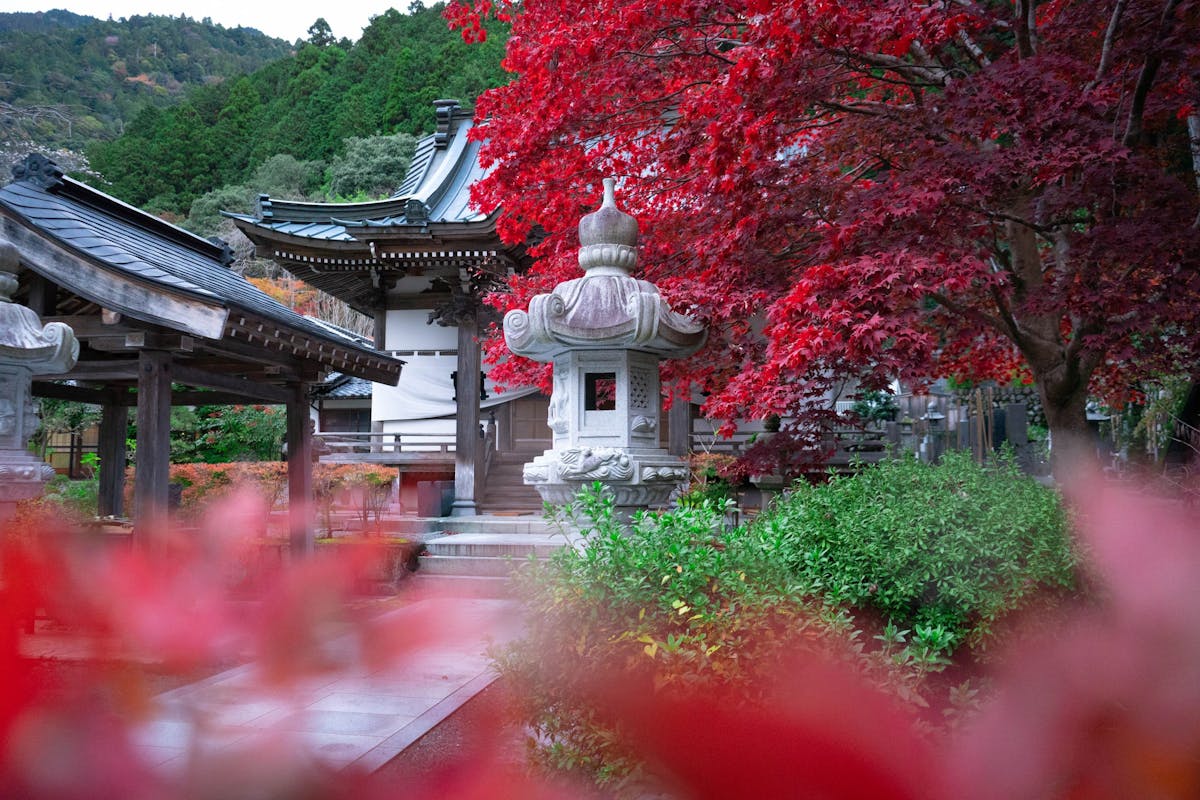
The real turning point came in the twelfth century. The Zen monk Eisai (栄西), returning from China in 1191, brought back tea seeds that he planted in several regions of Japan. He wrote the Kissa Yōjōki (喫茶養生記, "Treatise on Tea and Health"), the first Japanese work devoted to the benefits of tea. Thanks to Eisai, tea cultivation spread beyond aristocratic and monastic circles, gradually reaching the warrior classes.
During the thirteenth and fourteenth centuries, the fashion of whisked powdered tea, inherited from Song dynasty China, swept through the samurai class. Tea became a prestige item, sometimes consumed during lavish tasting competitions called tōcha (闘茶). But it was between the fifteenth and sixteenth centuries that Sadō reached its most refined form, through the work of three founding masters. Murata Jukō (村田珠光) introduced the aesthetic of wabi (侘び), the beauty found in simplicity and imperfection, into the practice of tea. Takenō Jōō (武野紹鷗) deepened this philosophy by favoring humble utensils over luxurious Chinese pieces. Above all, Sen no Rikyū (千利休, 1522–1591) brought Sadō to its peak by codifying its rituals, refining its tools, and elevating the ceremony to a full-fledged spiritual art. His vision, a tea stripped of all artifice and centered on human connection, remains the foundation of Sadō as it is still practiced today.
Sadō is not the mastery of a protocol. It is the art of making every moment conscious, every gesture intentional, every encounter irreplaceable.
Omotenashi: Welcoming From the Heart
At the foundation of Sadō lies Omotenashi (おもてなし), a concept of hospitality that goes far beyond mere politeness. Omotenashi is an inner disposition, a way of being: the host devotes complete attention to the well-being of their guests, down to the smallest detail. In summer, they will choose a bowl with flared edges so the tea cools more pleasantly; they will select confections evoking the freshness of a river or the blue of hydrangeas. In winter, a narrow, deep bowl retains warmth, while sweets in warm hues recall the comfort of a hearth. Nothing is left to chance; everything is designed with the other person in mind.
But Omotenashi is not a one-sided act. The guest, in return, shows gratitude by carefully observing the bowl the host has chosen, by appreciating the calligraphy hanging in the alcove, by savoring every detail of the setting. This silent dialogue, where people communicate through attention rather than words, forms the living heart of the ceremony.
Several Japanese expressions capture this philosophy:
- Ichi-go ichi-e (一期一会), "one encounter, one chance." Every ceremony is unique and will never be repeated in exactly the same way. This principle invites us to live the moment with absolute awareness, knowing that this precise combination of people, light, season, and mood will exist only once.
- Ichi-za konryū (一座建立): the host and guests build the atmosphere of the gathering together, with sincerity. Each person contributes through an open and generous attitude.
- Wa-kei-sei-jaku (和敬清寂), the four fundamental principles of Sadō, often inscribed on the calligraphic scrolls that have adorned tea rooms for over four hundred years. Wa (和) stands for harmony, a mindset of mutual consideration. Kei (敬) embodies the respect between host and guest. Sei (清) evokes purity, not only physical but also inner purity. Jaku (寂) calls for tranquility, a calm and serene spirit, free from the agitation of the world.
Ichi-go ichi-e: this encounter will happen only once. Even the same people, in the same room, with the same tea, will never live the same moment twice.
The Chashitsu: A Universe in Miniature
The tea ceremony room, called Chashitsu (茶室), is a space designed to create a break from the outside world. Traditionally, guests reach it through a garden path called roji (露地), lined with mossy stones and stone lanterns, which prepares the mind for contemplation. The entrance itself, the nijiriguchi (躙口), is so low that one must stoop to pass through it. This gesture of humility is no accident: by forcing samurai and merchants alike to bow in the same way, it erases all social hierarchy before anyone enters the room.
Inside, the space is spare, deliberately modest. It contains the toko no ma (床の間), an alcove that houses a calligraphic scroll called kakejiku (掛軸) and a minimalist flower arrangement known as chabana (茶花). These elements are carefully chosen to match the theme and season: a blossoming plum branch in early spring, a scroll evoking the moon in autumn, a calligraphy of the four characters wa-kei-sei-jaku for a back-to-school ceremony.
Fire in Rhythm With the Seasons
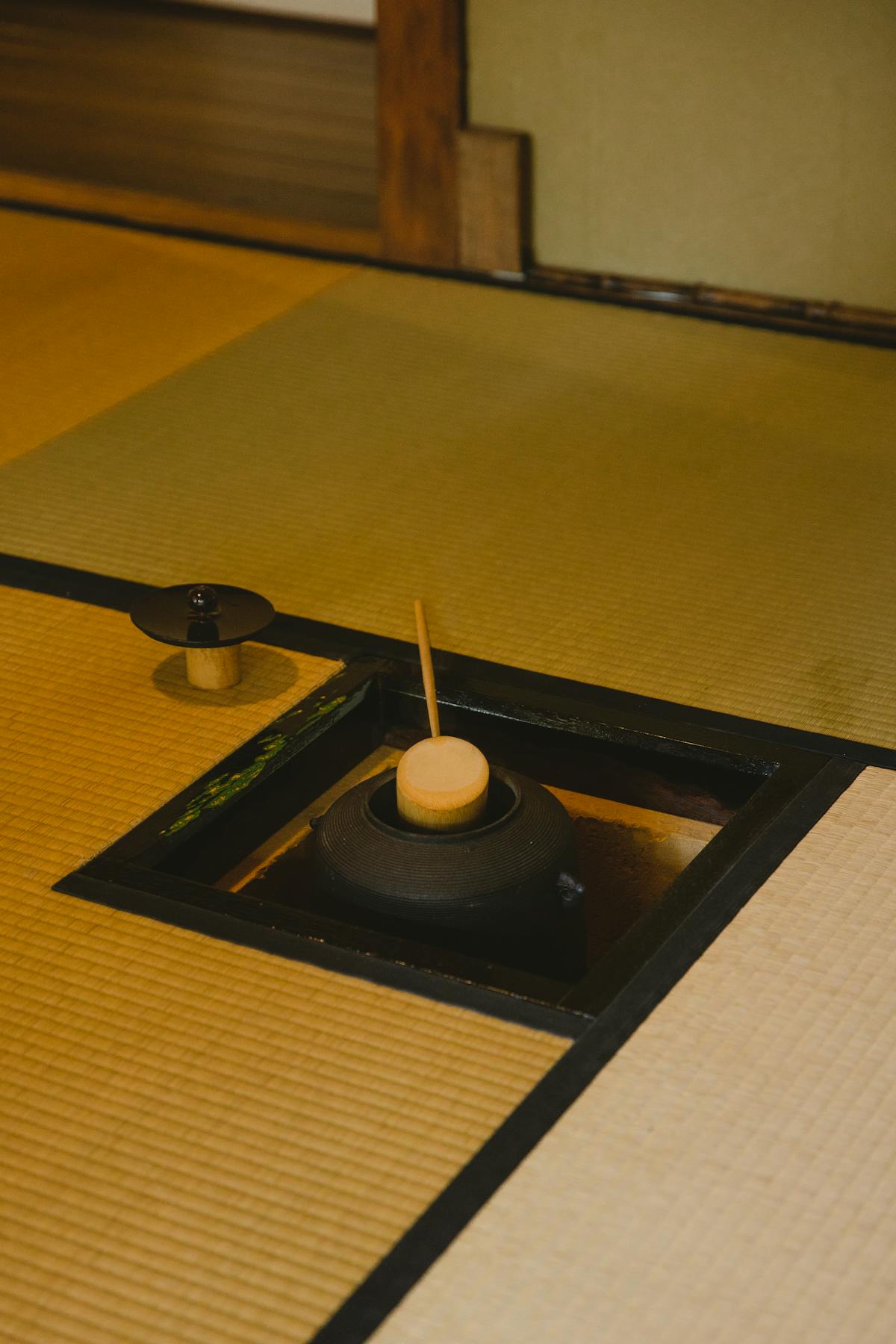
The heating of water follows the natural cycle. From May to October, the furo (風炉) is used, a portable brazier placed on the floor in which charcoal is set. From November to April, the ro (炉) takes over, a hearth built directly beneath the tatami, sunken into the floor itself. In winter, the kettle sits closer to the guests so they can feel its gentle radiant warmth. The door of the Chashitsu stays closed, and the intimacy of the room becomes a cocoon.
In summer, everything reverses: the kettle is deliberately placed far from the guests, and the door stays open to let the air flow in. This attention to the seasons runs through every aspect of Sadō, from the tools to the room layout to the choice of confections, reminding us that humans are not separate from nature but part of it.
The Objects of Sadō: Between Function and Contemplation
Every utensil used during the tea ceremony serves both as a functional tool and an object of contemplation, chosen with care for its aesthetics, texture, and resonance with the present moment.
The Chawan: Far More Than a Bowl
The Chawan (茶碗), the tea bowl, is the central object of the ceremony. The host's choice of Chawan is an act of silent communication. A Chawan adorned with cranes or bearing the character kotobuki (寿, longevity) will be reserved for New Year celebrations or festive occasions. Bowls with flared edges are preferred in summer because the tea cools faster; in winter, narrow and deep bowls are chosen to retain warmth longer.
After drinking, the guest takes time to admire the Chawan: its irregularities, its glaze, the marks left by the potter's fingers. This contemplation is not an afterthought; it is an act of gratitude toward the host, who selected this precise bowl for this precise occasion, and toward the artisan who shaped it.
Matcha: Emerald in Powder Form
Matcha (抹茶) is a green tea powder made from leaves grown in the shade for several weeks before harvest. This shading technique reduces sun exposure and stimulates the production of chlorophyll and amino acids (notably L-theanine), giving matcha its intense emerald color, its smoothness, and its characteristic umami. Unlike ordinary green teas, whose sun-exposed leaves develop more bitter catechins, matcha offers a round and enveloping flavor. The leaves are dried, deveined, then ground into a fine powder using granite stone mills, a slow process that preserves both aroma and color.
The Other Instruments
The chasen (茶筅), a bamboo whisk hand-carved into dozens of fine tines, is used to beat the matcha into the hot water until a smooth, creamy foam forms. The chashaku (茶杓), a bamboo scoop carved from a single piece, measures the powder with precision. The natsume (棗), a small black lacquer container, holds the matcha. And the fukusa (帛紗), a square of silk, is used to ritually purify the utensils before use, a gesture that symbolizes physical cleanliness as much as the host's purity of intention.
Okashi: Confections of the Seasons
The confections, called okashi (お菓子), are served before the tea to soften the palate and prepare the taste buds for the subtle bitterness of matcha. They reflect the theme of the ceremony and the emotion of the season: translucent cherry petals in spring, glowing red maple leaves in autumn, melting snowflakes in winter. Motifs of cranes and turtles, symbols of longevity, or the traditional combination of red and white mark celebrations such as New Year, coming-of-age day, or a wedding.
Each okashi is an edible poem. Before you even taste it, you contemplate its shape, its color, its name, the way you might read a haiku that captures a season in three lines.
The Seven Precepts of Sen no Rikyū
More than four hundred years after the death of Sen no Rikyū, his teachings continue to guide every gesture in Sadō. His seven precepts, disarmingly simple, distill the entire philosophy of the ceremony:
- Make a satisfying tea: not perfect according to some abstract standard, but adapted to the guest and the moment.
- Arrange the charcoal so that the water boils efficiently: master the practical gestures with precision and economy.
- Evoke coolness in summer and warmth in winter: live in harmony with nature rather than against it.
- Arrange the flowers as they are in the fields: do not force beauty; let it reveal itself.
- Be ready ahead of time: careful preparation is a form of respect toward those you welcome.
- Prepare for rain even in fair weather: anticipate with serenity, without anxiety.
- Show the greatest consideration for your guests: the heart of everything else.
The story goes that a disciple, disappointed by the apparent banality of these rules, pointed out to Rikyū that he already knew them. The master replied calmly: "If you can put them into practice perfectly, then I will become your student." The lesson is clear: Sadō does not reside in knowing the rules, but in the depth with which you embody them.
The Flow of a Ceremony

A tea ceremony follows a precise protocol where every gesture carries intention and every word has its place. Here are the essential steps.
The guest enters the Chashitsu by stooping through the nijiriguchi and kneels before the toko no ma to observe the kakejiku and the chabana. This is a moment of silent contemplation, an opportunity to read the calligraphy and appreciate the theme chosen by the host.
The okashi is then tasted, placed on a sheet of white paper folded in half called kaishi (懐紙). The confection is savored slowly, in preparation for the tea to come.
Before drinking, the guest addresses the person seated beside them. They place the bowl between the two of them and say "Osakini" (お先に, "Excuse me for drinking before you"), a gesture of consideration toward the other guests waiting for their turn.
The guest then greets the host by placing the Chawan in front of them and saying "Otemae chōdai itashimasu" (お点前頂戴いたします, "I receive this tea with gratitude"), expressing appreciation for the care put into the preparation.
Before bringing the bowl to their lips, the guest rotates it twice to the right. This gesture has a dual meaning: it allows the guest to see the opposite side of the Chawan, but more importantly, it avoids drinking from the "main face," the side the host deliberately oriented toward the guest as an offering.
Upon finishing the last sip, the guest draws in the tea with a soft audible sound, an elegant way of telling the host "I savored this tea to the very last drop." They then wipe the rim of the bowl with their fingers and rotate it to the left to return it to its original orientation.
Finally comes the moment to admire the Chawan. The guest holds it low, tilted toward the ground to prevent any risk of breakage, and observes its curves, its texture, its imperfections. This moment of contemplation is a silent tribute to the potter's work and the host's choice; the circle of Omotenashi closes.
Mitate: Inventing Your Own Ceremony
Sadō does not belong in a museum. The concept of Mitate (見立て), which could be translated as "seeing anew," encourages the use of objects not traditionally associated with the ceremony. A contemporary vase in place of a classic vessel, a cloth with modern patterns for the fukusa, a handmade artisan cup as a Chawan: Mitate reminds us that it is the intention that makes an object sacred, not the other way around. You can even substitute green tea or black tea for matcha, although matcha remains the traditional choice.
To design their ceremony, the host draws on the seasons or on meaningful events in their guests' lives: a birthday, a graduation, a memorable trip. They weave personal references into every element: a country of origin, a shared passion, a common memory. It is this attention to the other person that transforms a codified ritual into a living experience, profoundly human and renewed each time.
As for attire, there is no need for a kimono: simple, understated clothing will do. Custom simply asks that you wear white socks out of respect for the tatami, and that you remove rings and watches to avoid any risk of damaging the precious Chawan during handling.
Sadō teaches that there is nothing ordinary about preparing tea for someone. What is ordinary is doing it without putting your heart into it.
Chanoyu is neither a folkloric performance nor a frozen relic of the past. It is an invitation, always renewed, to slow down, to observe, to welcome the other person with all the attention you can muster. In a world saturated with distractions and speed, the small tea room with its walls of earth and paper offers a lesson of radical simplicity: to be fully present, together, for the time it takes to share a bowl of tea.
Photo credits: the images used in this article come from Pexels and Unsplash and are royalty-free.
Written by Chloé
Passionate about East Asian cultures, otome games and shojo manga. Every article is a deep dive into what I love.